
Plays of the 00s: Jar the Floor
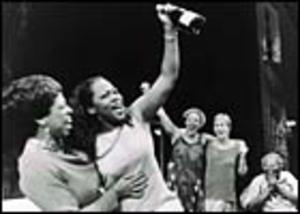 Another play of the 1990s, this one written in 1991 and produced most famously as part of the Second Stage's 1999 season, that nonetheless scoots into this series based on awards recognition: co-lead Lynne Thigpen, a then-recent Tony winner for Wendy Wasserstein's An American Daughter, copped an Obie for her no-doubt invigorating comic performance as Lola in Cheryl West's Jar the Floor, a rowdy comedy played over the painful conflicts and striations among four successive generations of one family in the Chicago suburbs. Though Thigpen was barely 50 when the play opened, her Lola is already the grandmother of a sometime college student named Vennie, whose mother Maydee, also Lola's daughter, is an African American Studies professor awaiting a tenure verdict. The women have collected on for the 90th birthday of the grand matriarch MaDear, now of limited agility but hardly qualified in sternnes or force of expression, even if the play slightly loses sight of her once the sparks start flying among her daughter, granddaughter, and great-granddaughter. The only other member of the dramatis personae is a white Jewish woman named Raisa, who appears jovially and all but unannounced at Vennie's side, setting off much speculation among the rest of the family that there won't, as it were, be any further generations.
I say that MaDear gets a bit short-shrifted dramatically, and again I suspect that her interpreter (at Second Stage that was The Ladykillers' Irma P. Hall) would need to find ways to generate a dynamic character out of MaDear's surreptitious clocking of conversations that don't include her and by bringing into focus the play's wispy ideas about the old woman's senile pining for dead husbands and absentee sons whose departures she either refuses to admit or is genuinely confused about. But then again, especially because the play starts with MaDear, gives her some early hijinks to play with a new electric wheelchair, and uses her birthday as its organizing event, one can imagine how easily Jar the Floor could have tipped into the kind of generic "Mama on the Couch" Play that George C. Wolfe so memorably skewered in The Colored Museum. West isn't willing to turn old age into zany or pathetic burlesque, and her play isn't about the imperious wisdom of the elderly. In fact, given how much the play respects the very different choices, personas, and goals of its very different characters, but also how frank it is about each woman's different fallibilities, West couldn't afford to imply that Mama or Grandma or Great Grandma knows best. Who ever learns anything in this life? Who's in the best position to lecture anyone else, to give or deny them anything, to talk or to listen?
 These aren't the most earth-shattering questions, or at least they aren't novel questions, but I think it's rare for a script to spin them with as much comic verve as West finds in the overlapping dialogues and boisterous idioms of her characters. These women are persuasively related despite being archetypally different; West's dialogue smartly zeroes in on the compressed quips and broken exchanges in which people who really know each other deliver their barbs and jests and reassurances. Family doesn't usually need big monologues or spit-polished, sophisticated badinage; it thrives, for better and for worse, on laser-targeting and quick flashes of tone, not the kind of heavily-worked dialogue that sells the playwright more than the play. If it's fair to paint Jar the Floor as an occasional laundry list of women's grievances with each other and with the world, I don't share the Village Voice's sense that the best way to honor West's achievements is to fit the deliciously round peg of her play into a pedantically square hole of Greek "anagnorisis," or the NY Times' implied conviction that intramural disputes among women are the stuff of "well-made television movies," undeserving of praise as stage drama. Jar the Floor resembles, increasingly, a sort of Dancing at Lughnasa for the Sisters, and line for line, its dialogue strikes me as funnier and more richly playable than Brian Friel's is, and without all the mopey sanctifying of a "memory play" device. Yes, the women talk a lot about the men who have left or disappointed them, but this emphatically is not The Women: absent men do not structure this piece, and it's lunacy to pretend that the women aren't mostly talking about themselves and each other.
And vividly at that: Lola's coloratura riffs of profanity, annoyance, tough love, and goodtime-gal hedonism yield at least one memorably tangy line per page, and West repeatedly nails "small" scenes or actions that often elude the Simons and Wassersteins who are so punchline-driven that they don't let their episodes breathe with human detail. When West shows us a mother's maladroit purchasing of clothes for her daughter, or a daughter's doling out of irritatingly cheap gifts, or the queasy outer-limits of a cancer survivor's brazen self-confidence, or a reluctant grandmother's repeated insistence that she isn't going to say nothin' about anything (and then keeps talking), or the tin-eared comparisons that a white guest draws between these black women's intramural dynamics and those of her own family, she compellingly sketches the moment and the women involved. She's a bit stronger, I think, with these smaller, character-revealing moments than with big cruxes related to large caches of money, and there's a last-minute revelation of affronts from the past that surely would have been better served if revealed a bit earlier in the play, and worked through a bit longer. I'm not blind to Jar the Floor's limitations, but I'm heartily entertained by its zest and vitality, and engaged by its insights and astute observations of human behavior, however heightened.
posted by NicksFlickPicks @ 12:00 AM
4 Comments

 Misconceptions: that because star Claudia Shear also wrote this play about Mae West, the piece is a one-woman show; that biographical plays are doomed as a genre, particularly on the page, where they lack even the diversion of a virtuoso mimic; that because I've never heard anyone mention Dirty Blonde in any context beyond the Tony roster, it was a "filler" nominee.
 Still, Dirty Blonde probably would feel like one actress-writer's opportunistic grab for convenient impersonation if the modern-day plot between film archivist Charlie and sometime-actress Jo weren't so colorful and layered, surprising in ways that mostly avoid seeming "forced" or boringly refractory of the same ideas breathing out of Mae's scenes. Their talk is just as vivid as Mae's, even if they themselves are pretty average folk: Jo has reason over the course of the play to profess just how fond and unjudgmental of Charlie she is, and she doesn't mince words, any more than Mae does when she launches a blistering attack on Ernst Lubitsch ("Why you Dutch bastard! Why don't you go back home and stick your finger in a dike!"). Their odd, unexpected process of getting to know each other pertly but tenderly reveals what's complex about all of us, without pretending that almost any of us are as "big" or as suggestive of greater meanings as Mae was. Dirty Blonde captures what the moments feel like when we get away with something we shouldn't (whether by scoring with a lewd joke or by sneaking an iced coffee into a controlled-air library vault), and what moments feel like when they're so rare and so beyond our power to see them coming that we know they'll dictate the rest of our lives, for better and for worse. The Sunset Boulevard-ish cuts to Mae's decrepit years are pitiful, funny, but refusing of dewy idealism, but best of all, they're even more interesting about Charlie than they are about Mae.